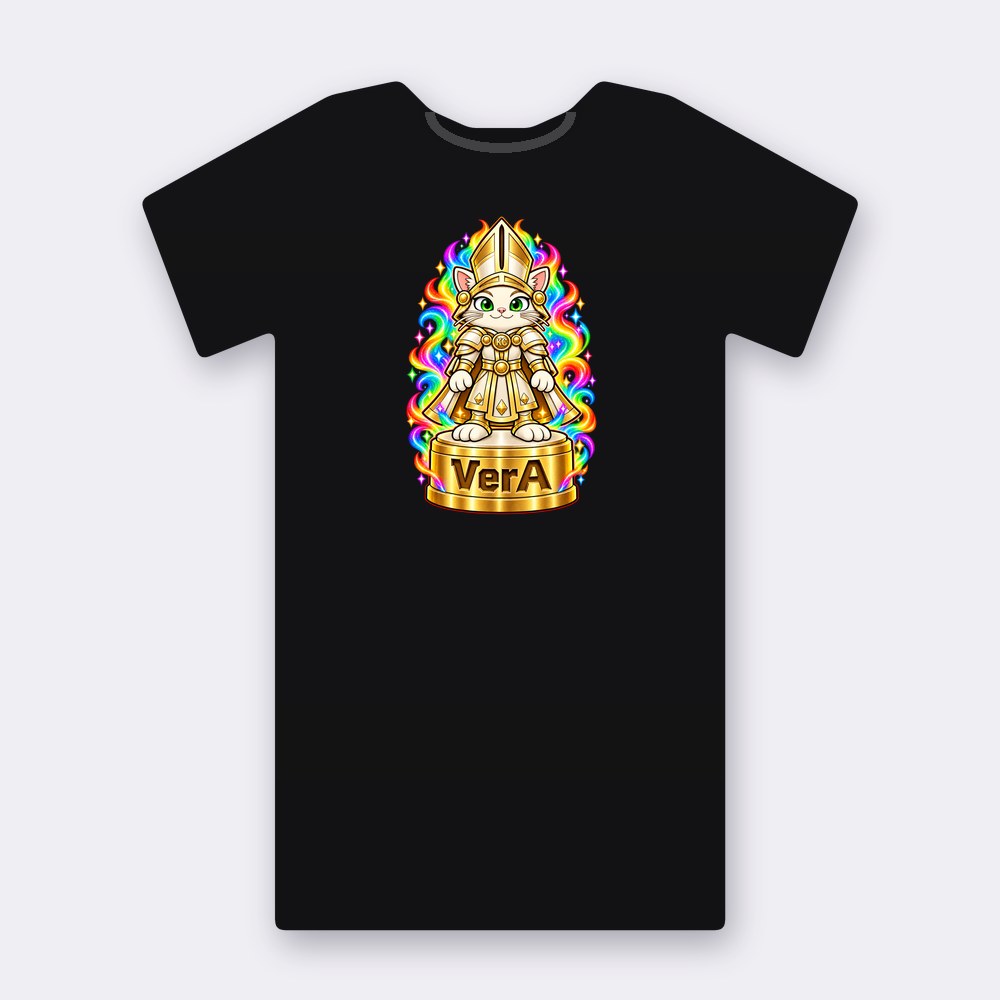
Who is VerA?
VerA is a bishop of Team White, the rainbow side: white cats with green eyes in golden armour and ermine, standing on golden pedestals framed by swirls and sparkles. The name: «vera» means true. VerA wears a tall golden mitre and golden armour.
VerA always tells the truth, and she always stays on her colour: a bishop that starts on a light square ends the game on a light square. She is the loyal one, the honest friend, the cat who sees the long diagonal while everybody else is staring at the centre.
The story behind the name VerA
Vera is the Latin word for true, the same root as verdict («a true saying») and verify. In Russian, Вера (Vera) means faith, and it is one of the most popular girls' names in Eastern Europe.
There is also the legend of Saint Veronica, whose name was later explained as vera icon, the «true image». Truth, faith and a true picture – VerA is the honest cat of the team.
How does VerA move?
The bishop moves diagonally, as many squares as it likes, but it cannot jump over other pieces. Every bishop stays on the colour it starts on for the whole game: one bishop of each team runs on the light squares, the other on the dark squares. A bishop is worth about three pawns, and two bishops together are a powerful pair in open positions.
Tap any square and VerA moves there. Pink dots show where VerA can go.
The bishop in history
The bishop began its life as an elephant. In Indian and Persian chess it was a war elephant, and in Arabic it was called al-fil, the elephant – which is why the piece is still called alfil in Spanish and alfiere in Italian. It was weak back then: it jumped exactly two squares diagonally.
War elephants were real: Alexander the Great faced them in India, and Hannibal famously crossed the Alps with elephants in 218 BC to attack Rome. When chess reached medieval Europe, nobody there knew elephants, and the piece turned into a bishop – the Lewis chessmen, carved from walrus ivory in the 12th century, already show bishops with mitres.
Other languages kept other ideas: in French it is the fou, the jester, and in German the Läufer, the runner.
VerA's favourite move: The fianchetto
Her favourite set-up is the fianchetto: she steps into the pocket behind a pawn on b2 or g2 and aims down the longest diagonal of the board, from corner to corner. From there VerA sees everything, quietly, without ever leaving her colour.
VerA on the board
The opposite number on the other side is TrugO. Want to play against Team Black? You can play KC Chess in the KC Catsino on klittycrew.com.
More cats of Team White: