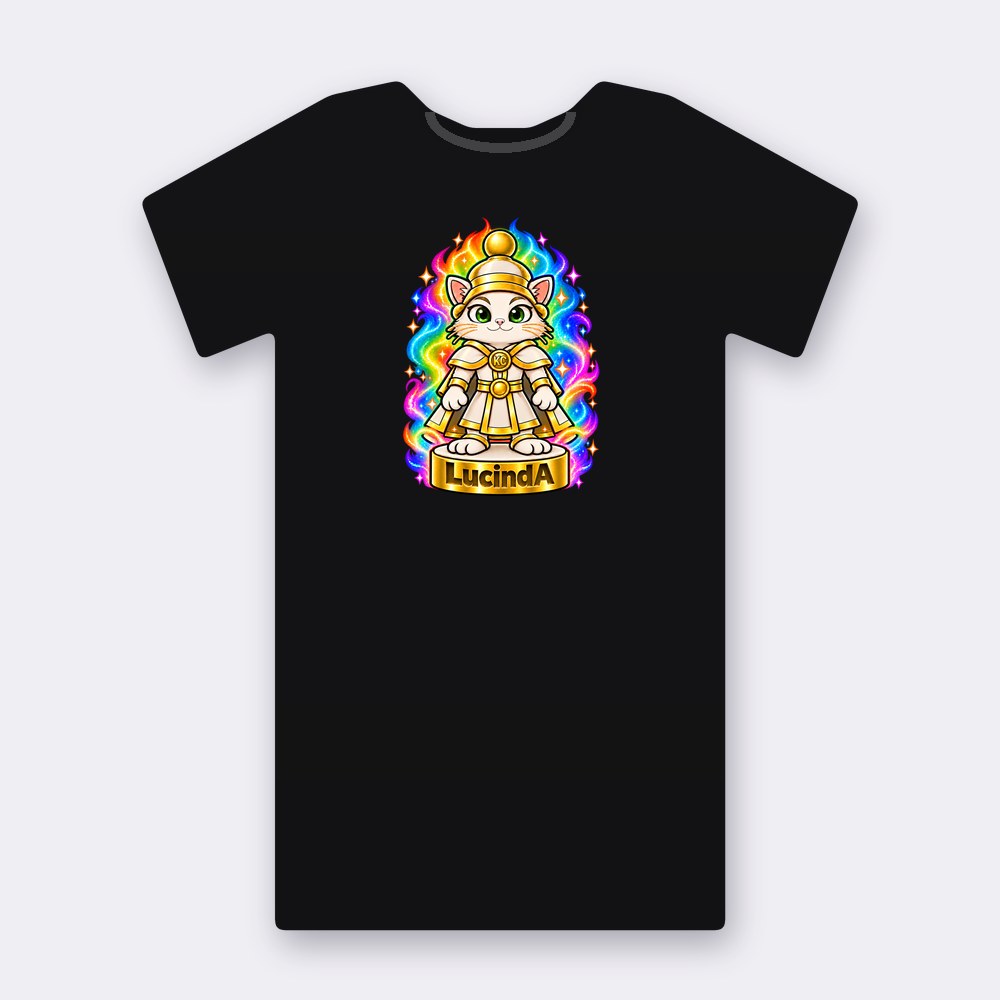
Who is LucindA?
LucindA is a pawn of Team White, the rainbow side: white cats with green eyes in golden armour and ermine, standing on golden pedestals framed by swirls and sparkles. The name: her name carries «luz», light. LucindA wears a golden pawn helmet and cape in a sparkling glitter glow.
LucindA is the brightest little piece on the board. She loves the special rules nobody remembers and the tricks that make the other side say: wait, is that even allowed?
The story behind the name LucindA
Her name comes from the Latin lux, light – the same root as the Spanish and Catalan luz and llum. Lucinda is also a heroine in Cervantes' Don Quixote (1605), one of the first great novels of Europe.
Light was precious in history: before electricity, people lived by candles, oil lamps and fire. A little pawn that shines brings light to a board of black and white.
How does LucindA move?
The pawn moves straight forward one square – and from its starting square it may move two squares at once. It captures differently from how it moves: one square diagonally forward. A pawn never moves backwards. When a pawn reaches the far side of the board it is promoted and becomes a queen, rook, bishop or knight. There is also one rare special capture, en passant, when an enemy pawn rushes past with a double step.
Tap any square the pawn can reach and LucindA moves there. Pink dots show where LucindA can go; the faded pieces show the diagonal captures.
The pawn in history
The pawns are the foot soldiers. The word comes from the Old French peon and the Latin pedo, someone who goes on foot – in Spanish they are still peones. In Indian chess they were the infantry of the army, and they have always been the most numerous pieces.
Foot soldiers decided most of the wars in history: the Greek hoplites who fought side by side in the phalanx, the Roman legionaries, the medieval peasants called up by their lords, the Swiss pikemen who were feared all over Europe in the 15th century. And they paid the highest price. That is why people still say someone is «just a pawn» when they are used by the powerful – a word that became bitter in the trenches of the First World War, where millions of ordinary soldiers died.
In chess, though, the pawn has a dream no real soldier had: if it reaches the other side, it becomes a queen. The great French player François-André Danican Philidor wrote in 1749 that the pawns are «the soul of chess», because the way they stand decides the whole game. The double step was added in medieval Europe to make games faster, and en passant followed to keep the double step fair.
LucindA's favourite move: En passant
Her favourite trick is en passant, the sparkliest rule in chess. When an enemy pawn uses its double step to rush past her, she may capture it as if it had moved only one square – but only on the very next move. Blink, and the chance is gone.
LucindA on the board
On the other side of the board, DolorS, GrimM, GrollO, GrumbL, NeidO, RotZ, ToyakO, ZankT are waiting. Want to play against Team Black? You can play KC Chess in the KC Catsino on klittycrew.com.
More cats of Team White: